
From a Village Classroom to a Genomics Lab

When Jupiter Marina Kabahita lost both of her parents at age eight, she moved in with an aunt who could only afford to send her to an under-resourced school in the village. Jupiter said that at the time it "felt like the world's end."
What she didn't know was that her school had support from half a world away. Mukono Boarding School has been a Sister Schools partner for years. It has grown into one of the best schools in the region, but in the early days of our partnership every single pencil we sent was critical for a student like Jupiter. The supplies our students in Washington collected and shipped made their way into Jupiter's hands: the notebooks, pens, and basic materials that make it possible to actually do the work a bright student is capable of. Jupiter used them. She earned outstanding grades and test results, won scholarships to high-quality secondary schools, and went on to complete a Master's degree in bioinformatics at Makerere University.
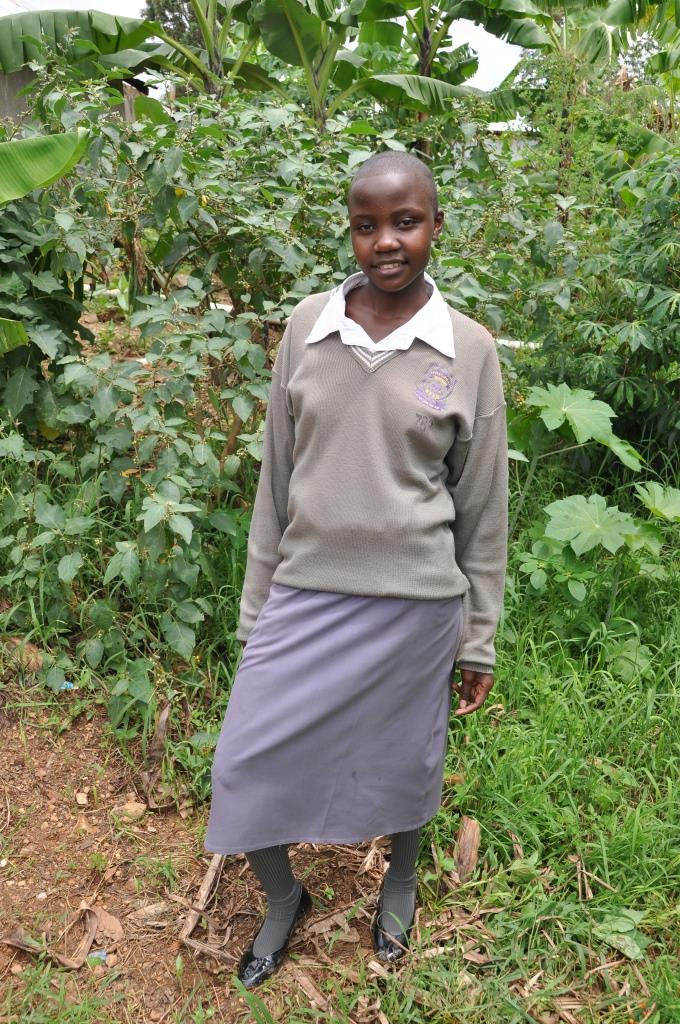
Today Jupiter is a SANTHE PhD Fellow at Makerere, studying a question with real consequences for TB patients across Africa. Millions of people take medication to keep a latent tuberculosis infection from turning into active disease, and for most of them the treatment does its job without incident. A smaller group ends up harmed by it, and until recently no one could say why. Jupiter is looking for the answer in genetics. She examines how variations in specific genes change the way a person's body breaks down the two drugs in 3HP, a weekly regimen taken over three months, with the goal of giving doctors a way to identify vulnerable patients at the start of treatment instead of discovering the risk once someone is already sick.
There's a bigger imbalance behind her research, and she names it directly. "African populations have the greatest genetic diversity in the world, yet they remain underrepresented in pharmacogenomic research," she told SANTHE. "Findings from European or Asian populations may not always apply to Africans." Her career has run through some of Uganda's most important public health institutions, including the National TB Reference Laboratory and a WHO-affiliated reference lab, and she currently tracks drug resistance patterns in tuberculosis, HIV, Mpox, and Ebola at the country's Central Public Health Laboratory. She does not treat any of it as abstract. "Every dataset represents real patients and real families".
We tell this story carefully, because we don't want to overstate our part in it. Jupiter's accomplishments are her own. The determination that carried an orphaned eight-year-old from a village school to a doctoral fellowship came from her, and from an aunt who took her in, and from teachers who saw what she could do.
But talent alone doesn't finish school. A student without paper cannot practice. A student without a pencil cannot sit the exam that decides the rest of her life. That is the narrow, unglamorous gap Sister Schools exists to fill, and it is why a shipment of school supplies is never really about school supplies. It is about making sure that when a student has the ability and the will, nothing as small as a shortage of notebooks is what stops her.
"African scientists can lead world-class genomics research while addressing health challenges that are most relevant to our populations," Jupiter said. She is proving it. Somewhere in a Ugandan primary school right now is another student waiting for the same small leg up.
You can read the full profile of Jupiter's research on the SANTHE website.


